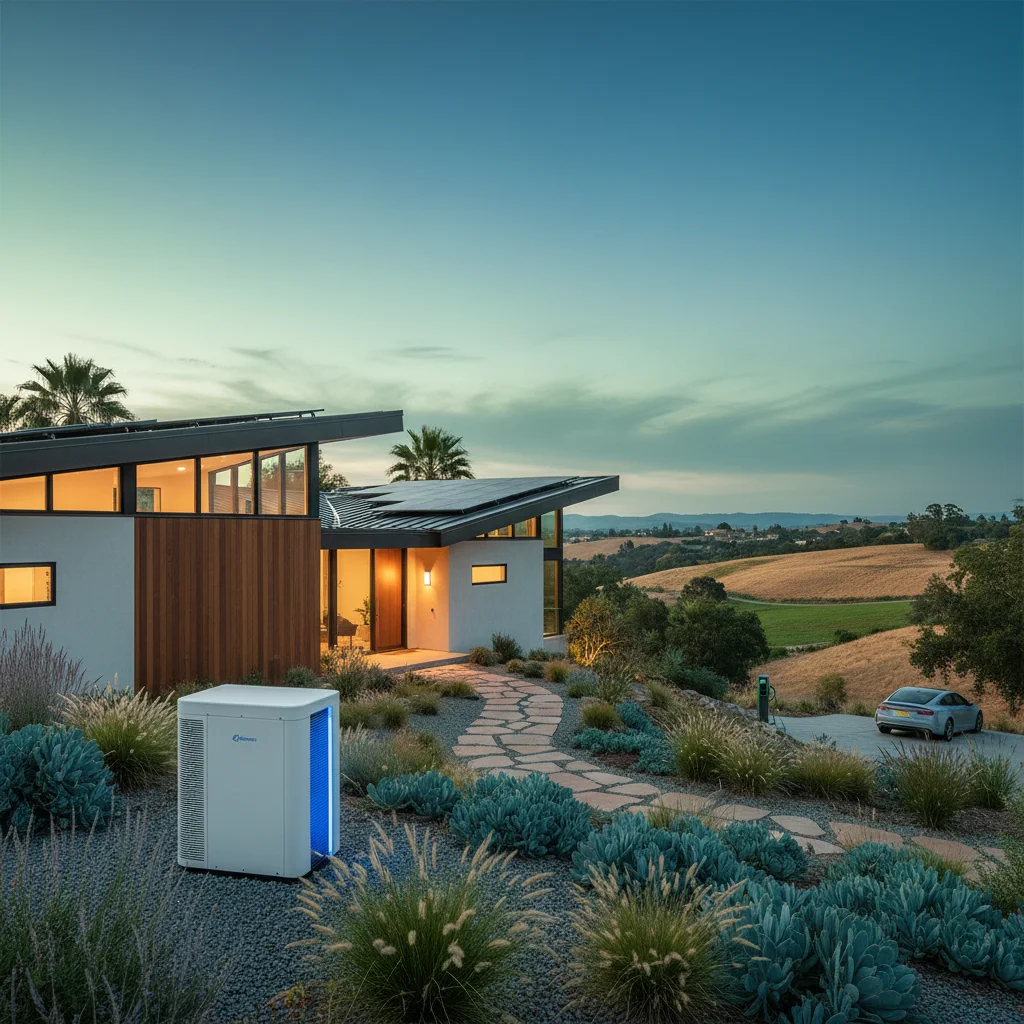
Air Source Heat Pump Cost California
Air Source Heat Pump Cost California: everything you need to know about eligibility, amounts, and the application process.
California homeowners replaced 127,000 furnaces and air conditioners with air source heat pumps in 2025, and the average installation cost dropped 18% from 2024 levels thanks to federal tax credits and state rebate programs that stack to cover up to $12,000 of the total expense. Air source heat pumps now deliver both heating and cooling for $8,000 to $18,000 installed, with equipment efficiency ratings that cut utility bills by 30-50% compared to traditional HVAC systems.
How Much Does an Air Source Heat Pump Cost in California?
Air source heat pump installations in California range from $8,000 to $18,000 depending on system size, efficiency rating, and labor rates, with 16 SEER2 models averaging $12,500 for a 2,000-square-foot home and 20+ SEER2 cold-climate systems reaching $16,000 before rebates.
Equipment costs account for 60% of total expenses at $4,800 to $10,800, while labor, permits, and electrical upgrades add $3,200 to $7,200. So the final price depends on whether your home needs a new electrical panel ($1,500-$2,500), ductwork modifications ($800-$3,000), or existing infrastructure that reduces installation complexity.
And California's climate zones drive system selection. Coastal homes in Zone 6 operate efficiently with standard 16 SEER2 units at $10,000-$13,000, but inland areas in Zone 13 that hit 105°F summers benefit from 18+ SEER2 models with variable-speed compressors priced at $14,000-$18,000. Cold-climate heat pumps rated for efficient heating down to -5°F add $2,000-$3,000 to baseline costs but maintain 75% efficiency at 5°F outdoor temperatures compared to 40% for standard models.
But system size matters more than homeowners expect. A correctly sized 3-ton unit for 1,500 square feet costs $11,000 installed, while an oversized 4-ton system wastes $2,500 on unnecessary capacity and cycles inefficiently. Manual J load calculations cost $300-$500 but prevent $5,000+ in long-term efficiency losses from improper sizing.
Labor rates vary by region. Bay Area contractors charge $95-$140 per hour versus $75-$95 in Central Valley markets, adding $1,500-$3,000 to identical installations based purely on location.
What's the Payback Period and ROI for Installing an Air Source Heat Pump?
California air source heat pump installations deliver payback periods of 6-10 years with annual utility savings of $800-$1,800, and homeowners who stack federal tax credits with state rebates recover upfront costs 40% faster than those who pay full retail prices.
A $14,000 system generates $1,200 annual savings by replacing natural gas heating at $1.80/therm and 15 SEER air conditioning, reaching break-even in 8.5 years before any incentives. And federal tax credits cover 30% of costs up to $2,000, while Tech Clean California offers $3,000-$6,000 for moderate-income households, cutting payback to 5-6 years.
So the ROI calculation depends on your baseline system. Homeowners replacing 80% AFUE furnaces and 13 SEER AC units save $1,500 annually with a 20 SEER2 heat pump, but those upgrading from 95% AFUE furnaces save just $600 per year because high-efficiency gas heating narrows the cost gap.
Electricity rates drive the equation. PG&E customers paying $0.38/kWh in Tier 3 see $1,800 annual savings, while SMUD customers at $0.18/kWh save $900 for identical usage patterns. But time-of-use rates reward heat pump owners who precool homes at off-peak rates, adding $200-$400 in annual savings.
Home value appreciation adds unrealized ROI. Zillow data shows California homes with heat pumps sell for 4.3% premiums versus comparable properties, translating to $21,500 higher sale prices on median $500,000 homes. And buyers in competitive markets prioritize energy-efficient HVAC systems, cutting days-on-market by 12% according to National Association of Realtors research.
Check your personalized payback period with our free rebate calculator that factors in local electricity rates and available incentives.
How Do Air Source Heat Pumps Compare to Other Heating Alternatives in California?
Air source heat pumps deliver 300-400% efficiency versus 80-95% for natural gas furnaces, translating to $600-$1,200 lower annual heating costs for California homeowners who replace conventional systems, and heat pumps provide both heating and cooling in one unit compared to separate furnace and AC installations that cost $12,000-$16,000 combined.
Natural gas furnaces cost $4,000-$7,000 installed but require separate $3,500-$6,000 air conditioning systems, totaling $7,500-$13,000 for complete climate control. And gas heating adds $900-$1,500 in annual fuel costs compared to $500-$800 for heat pump electricity at California's average $0.32/kWh rates. But gas furnaces maintain 95% efficiency in extreme cold, while standard air source heat pumps drop to 40% efficiency below 25°F outdoor temperatures.
Ductless mini-split heat pumps cost $3,000-$5,000 per indoor zone, reaching $9,000-$15,000 for three-zone installations that match central ducted systems. So mini-splits work for homes without existing ductwork, avoiding $5,000-$10,000 in duct installation costs, and they deliver zone control that cuts energy waste by 25-35% compared to single-thermostat central systems.
Ground source heat pumps achieve 500% efficiency by tapping stable 55°F underground temperatures, but installation costs reach $20,000-$35,000 with horizontal loop fields or $25,000-$40,000 for vertical boreholes. And geothermal systems pay back in 10-15 years versus 6-10 years for air source models, making them viable only for new construction or properties with large lot sizes that reduce excavation complexity. Learn more about geothermal tax credit programs.
Electric resistance heating costs $1,800-$3,500 for baseboard or wall heaters but operates at 100% efficiency, meaning every $1 of electricity produces $1 of heat versus $3-$4 for heat pumps. So resistance heating adds $2,400-$3,600 in annual costs compared to heat pumps in California's climate.
"Heat pumps can reduce electricity use for heating by approximately 50% compared to electric resistance heating such as furnaces and baseboard heaters." — U.S. Department of Energy
What Rebates and Incentives Can Reduce Your Air Source Heat Pump Costs?
Federal tax credits cover 30% of air source heat pump costs up to $2,000 through 2032 under the Inflation Reduction Act, and California programs stack an additional $3,000-$8,000 in rebates for income-qualified households, cutting total out-of-pocket expenses from $14,000 to $6,000-$9,000 for qualifying installations.
The federal Energy Efficient Home Improvement Credit applies to heat pumps meeting ENERGY STAR Most Efficient criteria with 16+ SEER2 cooling and 9+ HSPF2 heating ratings. And homeowners claim the credit on IRS Form 5695 when filing 2026 tax returns, receiving up to $2,000 back for qualifying equipment and installation costs. But the credit covers only heat pump equipment and labor, excluding electrical upgrades or ductwork modifications.
Tech Clean California offers $3,000 base rebates for moderate-income households earning 80-150% of area median income, with enhanced $6,000 rebates for those below 80% AMI. And the program requires contractor pre-approval and ENERGY STAR certification, with rebate checks arriving 6-10 weeks after installation completion. Visit the heat pump rebates guide for current program details.
Bay Area Air Quality Management District adds $3,000-$4,000 for homes replacing natural gas furnaces with electric heat pumps, combining with federal and state incentives to cover up to $12,000 of total costs. But the program restricts eligibility to properties in the nine-county Bay Area and requires permit verification showing complete gas furnace removal.
Utility company rebates vary by provider. PG&E offers $500-$1,000 for ENERGY STAR heat pumps, Southern California Edison provides $400-$800, and SMUD delivers $1,200-$1,800 for ducted systems. And time-of-use rate discounts cut electricity costs by $0.10-$0.15/kWh during off-peak hours, adding $200-$400 in annual savings for homeowners who preheat or precool during low-rate periods.
"The federal tax credit for heat pumps continues through 2032 at 30% of costs, with a $2,000 annual limit per household for qualified energy property." — ENERGY STAR
Local municipal programs supplement state and federal incentives. Fremont offers $750, Oakland provides $500, and San Jose adds $400 for heat pump installations within city limits, stacking with all other available rebates.
What's the Installation Timeline and Process for Air Source Heat Pumps?
Air source heat pump installations take 1-3 days from equipment delivery to system activation, with 4-8 weeks of lead time for permits, inspections, and contractor scheduling in California's high-demand markets, and complex projects requiring electrical panel upgrades or ductwork modifications extend timelines to 3-5 days of active work.
The process starts with a Manual J load calculation that determines correct system sizing based on home square footage, insulation levels, window efficiency, and local climate data. And contractors spend 2-4 hours measuring rooms, testing ductwork airflow, and calculating heat gain and loss, producing specifications that prevent undersized systems from failing to maintain temperature or oversized units that short-cycle and waste energy.
Permit acquisition adds 1-3 weeks depending on municipal processing times. Bay Area cities average 10-14 days, while rural counties process permits in 3-5 days. And permits cost $150-$400, covering electrical work, refrigerant handling, and HVAC equipment installation that requires licensed contractors with C20 HVAC and C10 electrical certifications.
Equipment procurement takes 1-2 weeks for standard models but extends to 3-4 weeks for high-efficiency cold-climate systems from Mitsubishi, Fujitsu, or Carrier during peak spring and fall installation seasons. So contractors who stock popular 3-ton and 4-ton units complete installations faster than those who special-order every system.
Installation day one includes removing existing equipment, mounting outdoor condenser units on concrete pads or wall brackets, and running refrigerant lines through walls or attics. And day two involves connecting indoor air handlers, testing refrigerant charge levels, calibrating thermostats, and performing airflow balancing to ensure even temperature distribution across all rooms.
Electrical upgrades add 4-8 hours when homes need 200-amp panel replacements to support 30-40 amp heat pump circuits. But modern heat pumps draw 15-25 amps, fitting within existing 150-amp service in 70% of California homes built after 1980.
Final inspections occur 2-5 days after installation, with city or county building departments verifying refrigerant connections, electrical safety, and permit compliance. And contractors schedule inspections before collecting final payment, ensuring homeowners receive signed-off permits required for rebate applications and future home sales.
Rebate processing extends the timeline by 6-12 weeks. Tech Clean California reviews applications in 8-10 weeks, federal tax credits apply when filing annual returns, and utility rebates arrive in 4-6 weeks after inspection approval.
Are You Eligible for California Air Source Heat Pump Programs and Tax Credits?
California homeowners qualify for federal tax credits regardless of income by installing ENERGY STAR certified heat pumps with 16+ SEER2 and 9+ HSPF2 ratings, while state rebates require income verification showing earnings below 150% of area median income, ranging from $93,000 for single-person households to $165,000 for families of four in high-cost Bay Area counties.
Federal eligibility requires three conditions. The home must be your primary residence, not a rental property or vacation home. And the heat pump must meet ENERGY STAR Most Efficient specifications, excluding budget 14 SEER2 models that fail efficiency thresholds. But vacation homes and rental properties don't qualify for the federal credit, limiting benefits to owner-occupied residences.
Tech Clean California sets income limits at 80% AMI for enhanced $6,000 rebates and 150% AMI for standard $3,000 rebates. And 80% AMI equals $74,400 for single-person households and $106,300 for four-person families in San Francisco County, while 150% AMI reaches $139,500 and $199,100 respectively. But income limits adjust by county, with lower thresholds in rural areas like Shasta County at $51,200 and $73,100.
Bay Area AQMD requires properties within the nine-county air district boundary, excluding Monterey, Santa Cruz, and San Luis Obispo residents who qualify for Central Coast air district programs instead. And applicants must remove existing natural gas furnaces completely, not retain them as backup heating sources, to receive the full $3,000-$4,000 rebate.
Rental properties qualify for utility rebates but not federal tax credits or Tech Clean California programs. So landlords access only PG&E's $500-$1,000 rebates and local municipal incentives, cutting total available incentives from $12,000 to $1,500-$2,500 for identical installations.
Manufactured homes and mobile homes qualify for all programs if permanently affixed to foundations with proper permitting. But park-model RVs and movable manufactured homes fail federal tax credit requirements for permanent residences. And ductless mini-split systems qualify for identical rebates as ducted central heat pumps, provided they meet ENERGY STAR efficiency specifications.
Multiple heat pump installations in the same year stack toward federal limits. Homeowners who install a $12,000 ducted system and a $5,000 mini-split in 2026 claim 30% credits on both, totaling $5,100, but the annual cap limits refunds to $2,000 maximum regardless of total qualifying expenses. Explore current energy tax credits for comprehensive program details.
Official Sources
- U.S. Department of Energy - Heat Pump Systems — Federal guidance on heat pump efficiency, savings calculations, and installation best practices
- ENERGY STAR Heat Pumps — Certified product directory and federal tax credit eligibility requirements
- DSIRE California — Comprehensive database of state, local, and utility rebate programs with current 2026 eligibility details
Frequently Asked Questions
How much does an air source heat pump cost in California?
Air source heat pump installations cost $8,000-$18,000 in California depending on system size, efficiency rating, and installation complexity. A standard 3-ton 16 SEER2 system averages $12,500 installed for a 2,000-square-foot home, while high-efficiency 20+ SEER2 cold-climate models reach $16,000-$18,000. And costs decrease 40-60% after applying federal tax credits up to $2,000 and state rebates of $3,000-$6,000 for qualifying households.
What rebates are available for air source heat pumps in California?
California homeowners access federal tax credits covering 30% of costs up to $2,000, Tech Clean California rebates of $3,000-$6,000 for income-qualified households, and Bay Area AQMD incentives of $3,000-$4,000 for gas furnace replacements. And utility companies add $400-$1,800 depending on provider, with PG&E offering $500-$1,000 and SMUD providing $1,200-$1,800. But programs require ENERGY STAR certification and income verification for state rebates.
Are air source heat pumps eligible for federal tax credits in 2026?
Air source heat pumps qualify for 30% federal tax credits up to $2,000 through 2032 under the Inflation Reduction Act's Energy Efficient Home Improvement Credit. And systems must meet ENERGY STAR Most Efficient criteria with 16+ SEER2 cooling and 9+ HSPF2 heating ratings. But the credit applies only to primary residences, excluding rental properties and vacation homes, and homeowners claim credits on IRS Form 5695 when filing annual tax returns.
How long does it take to get an air source heat pump rebate in California?
Tech Clean California rebates arrive 6-10 weeks after installation completion and application submission, while utility company rebates from PG&E and SCE process in 4-6 weeks following final inspection approval. And federal tax credits apply when filing annual returns, providing refunds 2-8 weeks after IRS processing depending on filing method. But Bay Area AQMD rebates take 8-12 weeks due to gas furnace removal verification requirements.
What is the difference between air source and ground source heat pumps?
Air source heat pumps extract heat from outdoor air and cost $8,000-$18,000 installed with 300-400% efficiency, while ground source heat pumps tap stable underground temperatures at $20,000-$40,000 installed with 500% efficiency. And air source systems install in 1-3 days versus 3-7 days for geothermal excavation. But ground source systems deliver consistent heating performance in extreme cold where air source efficiency drops below 40% at temperatures under 25°F.
Ready to calculate your savings? Use our free rebate calculator to estimate total incentives, payback period, and annual utility savings based on your home's specific details and local electricity rates. Get personalized results in under 60 seconds.
Last updated: April 14, 2026. Reviewed by the DuloCore Editorial Team. About our authors.
Find Your Rebates
Use our calculator to see how much you can save on your home improvement project.
Calculate My Savings