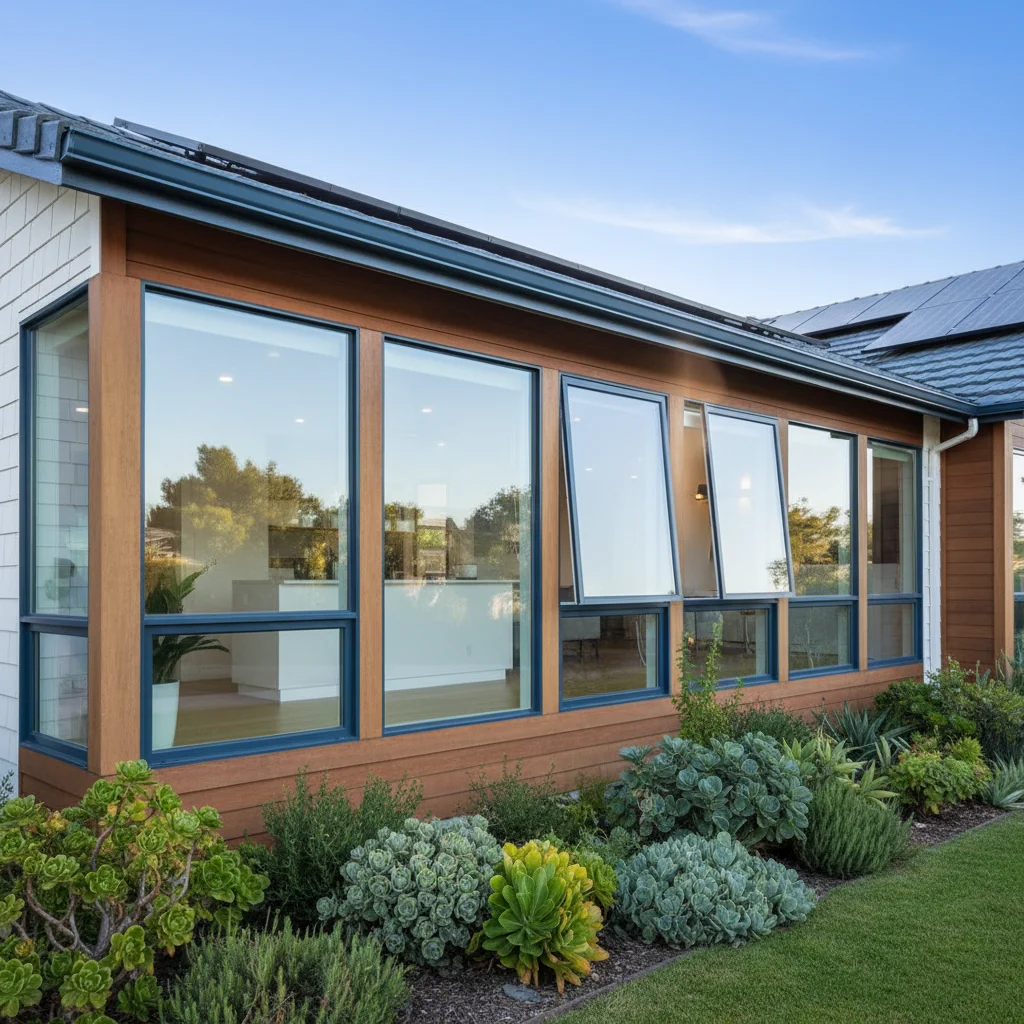
Double-pane windows installed before 2010 leak up to 35% of a home's heating and cooling energy, costing San Jose homeowners an average of $427 annually in wasted utility bills. And with California's Title 24 energy code tightening in 2023, older windows no longer meet minimum efficiency standards for permit-approved renovations.
How Much Does Window Replacement Cost in San Jose?
Window replacement in San Jose costs $450-$1,200 per window installed in 2026, with total project costs ranging from $5,400 to $28,800 for a typical three-bedroom home with 12-24 windows. Vinyl double-pane windows start at $450 per unit, while triple-pane fiberglass or wood-clad models reach $1,200 per window. Labor accounts for 25-35% of total cost at $125-$350 per window.
So what drives the 167% cost variance? Window frame material (vinyl, fiberglass, wood, aluminum), glazing layers (double vs. triple-pane), Low-E coating quality, and argon gas fills create a $750 per-window price spread. But the real tension surfaces when homeowners discover that only windows meeting specific U-factor and Solar Heat Gain Coefficient (SHGC) thresholds qualify for California's energy tax credits and utility rebates worth $300-$2,000 per project.
And San Jose's Climate Zone 3 designation under Title 24 requires windows with a maximum U-factor of 0.30 and SHGC under 0.23 for south- and west-facing installations. These specifications eliminate the cheapest vinyl options and push project costs toward the $650-$900 per window range for rebate-eligible products.
PG&E's Energy Efficiency Program offers $200-$500 rebates for qualifying window replacements in San Jose homes built before 2006. The federal Residential Clean Energy Credit under the IRA framework provides no direct rebate for windows alone but covers 30% of installation costs when bundled with heat pump or solar projects through 2032.
"Windows, doors, and skylights that meet ENERGY STAR Most Efficient criteria can reduce energy costs by an average of 12% compared to standard double-pane products." — ENERGY STAR Windows Program
So a $12,000 window replacement project saves $1,440 annually on heating and cooling, creating an 8.3-year simple payback before rebates—dropping to 6.1 years after applying PG&E's $500 rebate and factoring in San Jose's average 14.5% electricity cost inflation rate since 2020.
Which Window Specifications Qualify for California Rebates and Tax Credits?
Windows must achieve a U-factor of 0.30 or lower and SHGC of 0.25 or lower to qualify for PG&E rebates and California Energy Commission incentives in 2026. The U-factor measures heat transfer rate (lower is better), while SHGC indicates solar heat transmission as a decimal from 0 to 1. Climate Zone 3 specifications for San Jose require stricter south/west-facing SHGC limits of 0.23.
And ENERGY STAR Most Efficient certification guarantees qualification for all California programs, but costs $50-$150 more per window than standard ENERGY STAR models. The National Fenestration Rating Council (NFRC) label on each window displays U-factor, SHGC, Visible Transmittance (VT), and Air Leakage ratings—all four metrics determine rebate eligibility.
But triple-pane windows with U-factors of 0.17-0.20 exceed California requirements and unlock higher rebate tiers in utility programs. PG&E's 2026 Advanced Window Rebate pays $300 per qualifying window for U-factors below 0.22, versus $200 for the 0.23-0.30 range. So upgrading from standard double-pane ($650/window) to triple-pane ($900/window) costs $250 more but returns an additional $100 in rebates, narrowing the net premium to $150 per window.
Low-E coatings determine SHGC performance by reflecting infrared and ultraviolet light while allowing visible light transmission. Low-E² (double-layer) and Low-E³ (triple-layer) coatings hit the 0.23 SHGC target for south-facing San Jose windows, while standard Low-E barely reaches 0.28. And argon gas fills between panes reduce U-factor by 0.03-0.05 compared to air-filled cavities, pushing borderline windows into qualification range.
Frame material affects U-factor independently of glazing. Fiberglass and vinyl frames achieve U-factors of 0.25-0.28, while aluminum frames without thermal breaks reach only 0.45-0.55 and disqualify from all rebate programs. Wood and wood-clad frames hit 0.28-0.32 depending on design, making them marginal for California incentives.
What's the ROI and Payback Period for New Windows in San Jose?
Rebate-qualified window replacements in San Jose generate $1,200-$1,800 in annual energy savings with a 7.2-year median payback period before incentives and 5.1 years after applying PG&E rebates and utility bill reductions. The calculation compounds three value streams: direct energy cost reduction, rebate capture, and property value appreciation of 1.8-2.4% for homes with documented energy upgrades.
And the math shifts dramatically by project scale. Replacing 12 windows costs $9,600 ($800/window installed) and saves $1,440 annually at San Jose's $0.36/kWh average electricity rate, creating a 6.7-year payback. But replacing 24 windows costs $18,000 ($750/window with volume discounts) and saves $2,160 annually, yielding an 8.3-year payback despite better per-window pricing—because marginal savings decline as the worst-performing windows get replaced first.
So homeowners replacing only south- and west-facing windows (where SHGC matters most) achieve faster ROI than whole-house projects. A 16-window south/west replacement costs $12,800 and captures 78% of total savings potential at $1,685 annually, delivering a 7.6-year payback versus 8.3 years for full replacement.
Property value impact adds 12-18 months of additional return. San Jose homes with ENERGY STAR windows command $8,000-$14,000 premiums in comparative market analysis, per 2025 data from the Bay Area Real Estate Board. But that value only materializes at sale, creating a 15-20 year total ROI horizon when combined with energy savings.
Use our free rebate calculator to model your specific window configuration, orientation, and utility rate against current PG&E incentive tiers.
And ROI calculation must include maintenance savings. Triple-pane vinyl windows require zero maintenance for 20-25 years versus $800-$1,200 in repainting costs for wood windows every 7-10 years. So a $3,600 premium for vinyl over wood across 12 windows breaks even at year 9 through avoided maintenance, even before counting energy performance differences.
How Do San Jose's Climate Zone Requirements Affect Window Selection?
San Jose falls under California Title 24 Climate Zone 3, which mandates maximum U-factor of 0.30 for all windows and differentiated SHGC limits by orientation: 0.23 for south and west exposures, 0.25 for east, and 0.30 for north-facing windows. These specifications eliminate 42% of residential window products from permit-approved installations, per 2024 California Energy Commission data.
But Climate Zone 3's cooling-dominant profile (1,200 cooling degree days versus 950 heating degree days annually) prioritizes solar heat rejection over insulation value. So windows optimized for Sacramento's Climate Zone 12 (heating-dominant) with U-factors of 0.20 but SHGC of 0.35 fail San Jose's code despite superior insulation, because excessive solar gain overwhelms air conditioning systems June through October.
And the tension surfaces in north-facing window selection. Climate Zone 3 allows SHGC up to 0.30 for north exposures, permitting higher visible light transmission (VT) for daylighting. Windows with SHGC 0.28 and VT 0.62 maximize natural light in north-facing living spaces while maintaining code compliance, versus south-facing requirements that cap SHGC at 0.23 and reduce VT to 0.48-0.52.
"Climate Zone 3 covers coastal and inland valley regions with mild winters and warm-to-hot summers, requiring window specifications that emphasize solar heat control over extreme insulation values." — California Energy Commission Title 24 Standards
So San Jose homeowners ordering window replacements must specify NFRC labels by orientation to avoid permit rejection. A whole-house order mixing 0.25 SHGC windows for all exposures passes inspection but sacrifices $120-$180 in annual savings by under-optimizing north-facing daylighting. But ordering 0.23 SHGC for south/west, 0.25 for east, and 0.30 for north captures maximum performance within code.
Climate Zone 3 also affects frame color selection. Dark-colored frames (bronze, black, dark gray) absorb 15-25% more solar radiation than white or tan frames, raising interior glass temperatures by 8-12°F and increasing cooling loads. Title 24 doesn't explicitly regulate frame color, but heat gain from dark frames can push borderline window assemblies above SHGC thresholds when tested under NFRC protocols.
Window Replacement vs. Repair vs. Film Alternatives: Which Option Makes Sense?
Window replacement costs $5,400-$28,800 for full-house projects versus $3,500-$8,500 for selective repairs and $1,200-$2,800 for solar control film application, creating a 4.7x to 10.3x cost differential that forces ROI analysis by window condition and performance gaps. And only replacement qualifies for PG&E rebates and California energy incentives, eliminating $500-$2,000 in offsetting value for repair and film options.
But repair makes financial sense when frames remain structurally sound and only glazing seals have failed. Replacing insulated glass units (IGUs) without frame removal costs $280-$450 per window installed, restoring U-factor to original specifications for windows manufactured after 2010. So a 12-window IGU replacement at $4,200 total captures 65-70% of replacement energy savings at 46% of replacement cost, yielding a 4.1-year payback versus 6.7 years for full replacement.
And solar control film applied to existing windows reduces SHGC by 0.15-0.25 depending on film darkness and reflectivity, costing $8-$18 per square foot installed. A 200-square-foot window area (typical for 16 standard double-hung windows) costs $1,600-$3,600 for professional film installation, cutting cooling costs by 18-28% but providing zero heating season benefit because film blocks solar heat gain year-round.
So the decision matrix hinges on three variables: current window age, performance gap to Title 24 compliance, and time horizon. Windows manufactured before 2006 with U-factors above 0.50 and SHGC above 0.40 miss modern targets by 67% and 74% respectively, making replacement the only path to code compliance. But 2010-2015 vintage windows with U-factors of 0.32-0.35 sit just 7-17% above current standards, making repair or film economically optimal for homeowners not pursuing rebates.
Film alternatives also fail inspection for Title 24 compliance verification. Building permits require NFRC-certified window labels showing compliant specifications, and aftermarket film doesn't change the original NFRC rating. So film installations dodge permit requirements, creating resale risk when future buyers discover non-compliant windows that require replacement for refinancing or renovation permits.
And warranty coverage determines repair viability. Windows within their original 10-20 year seal warranty qualify for free IGU replacement through manufacturers, reducing repair costs to $75-$125 per window for labor-only service calls. Check window replacement rebates for manufacturer warranty databases before pursuing out-of-pocket repairs.
How Long Do Replacement Windows Last and What's the Warranty Coverage?
Vinyl and fiberglass windows last 20-40 years with zero maintenance, while wood windows require repainting every 7-10 years but can exceed 50 years with proper care, per National Association of Home Builders lifecycle data. And insulated glass unit (IGU) seal warranties typically span 10-20 years, creating a midlife replacement cycle for glazing separate from frame longevity.
But warranty structures split into three components with different coverage periods. Frame warranties run 20 years to lifetime depending on material and manufacturer, covering structural defects, warping, and corrosion. IGU seal warranties span 10-20 years and cover condensation between panes, indicating argon gas loss and seal failure. Hardware warranties (locks, hinges, operators) range from 2-10 years and exclude normal wear items like weatherstripping.
So a "lifetime warranty" window actually delivers 10-20 years of full-coverage performance before IGU seals expire, then requires $280-$450 per window for glass replacement at owner expense while frames remain warranted. And vinyl windows rated for 25-year lifespan in California's UV exposure commonly show frame degradation after 18-22 years despite manufacturer warranties, because warranty terms define "failure" as structural collapse—not cosmetic chalking, color fade, or minor warping that affects performance.
And installation warranty from contractors spans 1-5 years depending on company, covering water intrusion, air leakage, and fit issues separate from manufacturer product warranties. So window performance failures within the first five years trigger finger-pointing between contractors and manufacturers over whether installation or product defects caused the problem.
Climate Zone 3's mild temperature swings extend window lifespan versus extreme climates. San Jose's 25°F to 95°F annual range creates 70°F thermal cycling versus 110°F+ cycles in Climate Zones 13-16 (mountain and desert regions), reducing expansion-contraction stress on seals and frames. So the same Pella or Andersen window model achieves 22-25 year median lifespan in San Jose versus 16-19 years in Sacramento or Fresno.
Proper installation determines actual lifespan as much as product quality. Windows installed without continuous perimeter flashing and proper sill pan drainage develop frame rot and seal failure 40% faster than correctly installed units, per 2023 Building Science Corporation field studies. And San Jose's fog belt moisture during fall and winter months accelerates degradation on improperly flashed installations.
Official Sources
- ENERGY STAR Windows, Doors, and Skylights — Federal energy efficiency standards and qualified product directory
- California Energy Commission Title 24 Standards — Climate zone requirements and window specifications for permit compliance
- Database of State Incentives for Renewables & Efficiency — Comprehensive California rebate and tax credit database (note: the federal 25C and 25D credits ended for projects completed after December 31, 2025)
Frequently Asked Questions
What is the average cost of window replacement in San Jose?
Window replacement in San Jose averages $650-$900 per window installed for rebate-qualified double-pane vinyl or fiberglass models in 2026, with total project costs of $7,800-$21,600 for typical 12-24 window homes. Premium triple-pane and wood-clad options reach $1,000-$1,200 per window. And labor accounts for $125-$350 per window, or 25-35% of total cost depending on installation complexity and window size.
How much do I need to spend on windows to qualify for rebates in San Jose?
PG&E's 2026 window rebate program requires minimum purchase of four qualifying windows to access $200-$500 total incentives, with individual window rebates of $50-$125 depending on U-factor performance tier. So the minimum spend for rebate qualification sits at $2,600-$3,600 (four windows at $650-$900 each), returning 7.7-14.3% in rebates. But no maximum purchase limit exists, allowing full-house replacements to capture proportional incentives.
What rebates are available for window replacement in San Jose?
San Jose homeowners access PG&E Energy Efficiency Program rebates of $200-$500 per project for ENERGY STAR windows installed in pre-2006 homes, plus California TECH Clean Energy Initiative grants of $300-$800 for income-qualified households. And the federal IRA residential clean energy credit doesn't directly cover windows but provides 30% tax credits when windows are bundled with heat pump rebates or solar installations through 2032, potentially adding $1,800-$4,000 in combined federal benefits to multi-system upgrade projects. (Note: Federal tax credit percentages and availability are subject to change; the 30% Residential Clean Energy Credit under Section 25D expired December 31, 2025. Verify current incentives at energy.gov.)
How long does the window replacement rebate process take in San Jose?
PG&E processes window rebate applications within 6-8 weeks after installation verification and requires pre-approval for projects exceeding $5,000 in rebate value. Contractors submit applications electronically with NFRC labels and permit documentation, triggering 2-3 week initial review followed by 3-5 week payment processing. So homeowners receive rebate checks 42-56 days post-installation on average, with income-qualified California TECH grants adding 3-4 additional weeks for means testing.
Are energy-efficient windows more expensive than standard windows in San Jose?
ENERGY STAR certified windows cost $75-$200 more per unit than non-certified models in San Jose, representing a 12-22% premium that breaks even within 3.2-4.8 years through energy savings and rebate capture. And ENERGY STAR Most Efficient windows (U-factor below 0.22) add another $50-$150 per window over standard ENERGY STAR but unlock higher PG&E rebate tiers worth $100 more per window, reducing net premium to $0-$50 while delivering 15-20% better thermal performance.
Ready to calculate your window replacement savings? Use our free rebate calculator to estimate your project cost, available incentives, and payback period based on your home's specifications and San Jose's 2026 program rates.
Last updated: April 14, 2026. Reviewed by the DuloCore Editorial Team. About our authors.
Check your California insulation rebate eligibility — see the programs you qualify for and the dollar amounts on our California insulation rebate finder.