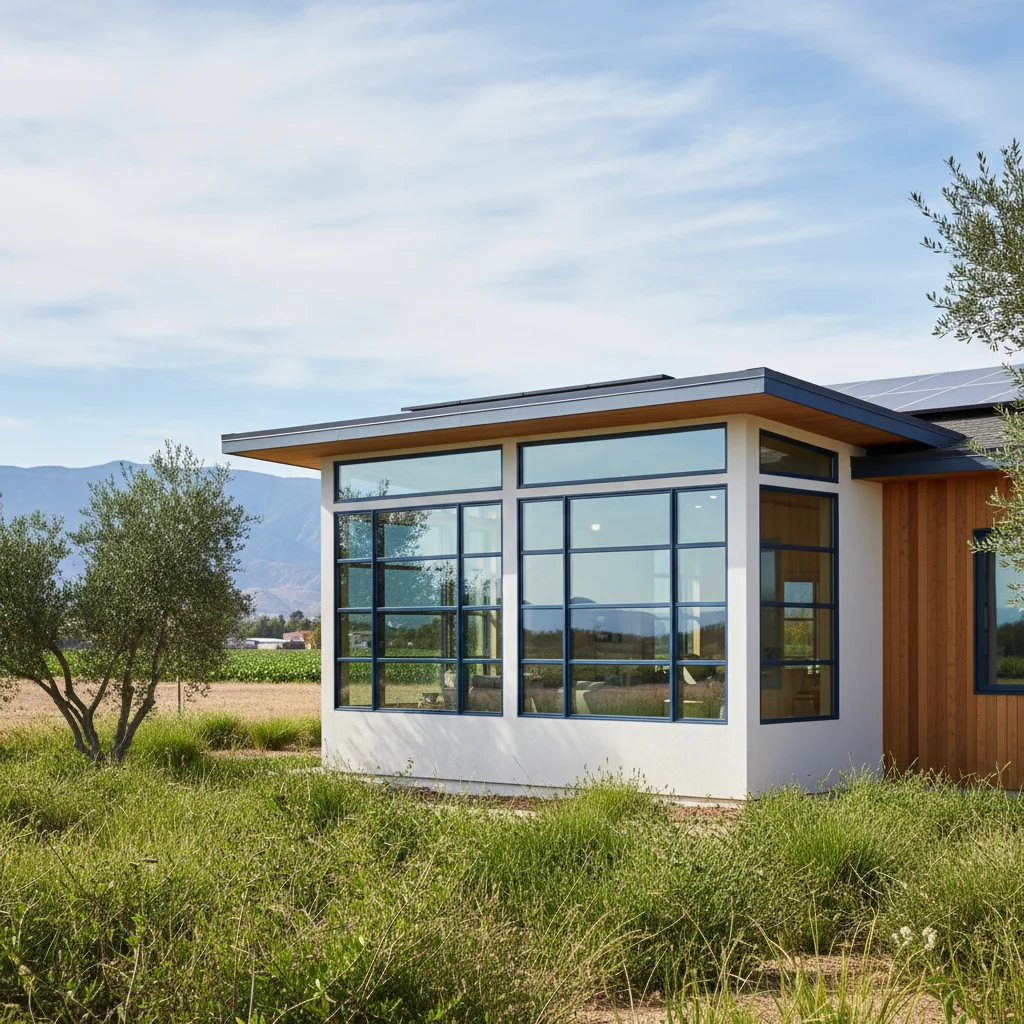
California homeowners paid between $8,400 and $18,200 for full-house window replacement in 2025, with Central Valley properties averaging $11,600 for 12 dual-pane vinyl windows — and that's before factoring in rebates that can cut costs by $2,000 to $4,500.
How Much Does Window Replacement Cost in the Central Valley?
Window replacement in the Central Valley costs $450 to $1,200 per window installed, with whole-house projects averaging $11,600 for a typical 12-window home. Vinyl dual-pane windows start at $450 per unit, while fiberglass triple-pane models with Low-E coatings reach $1,200 per window including professional installation.
And material choice drives 60% of total cost variance. Vinyl frames cost $450-$650 per window, aluminum runs $550-$750, wood hits $700-$950, and fiberglass tops out at $900-$1,200. But energy-efficient models with ENERGY STAR certification qualify for utility rebates that reduce net costs by $150-$375 per window.
Size matters too. Standard double-hung windows (24"x36") install for $450-$700, while picture windows (48"x60") run $800-$1,200. So a 2,000-square-foot home in Fresno replacing 15 windows typically spends $12,800-$16,500 for mid-grade dual-pane vinyl with professional installation.
Labor accounts for 30-40% of project costs. Central Valley installers charge $150-$250 per window for standard installations, with complex jobs involving structural repairs adding $400-$800 per opening. Or homeowners tackle DIY installs and save $2,000-$4,000 on labor — but sacrifice manufacturer warranties that require professional installation.
What's the ROI and Payback Period for Window Replacement?
Energy-efficient window replacement delivers 68-78% ROI at resale and recovers costs through energy savings in 12-18 years. Upgrading from single-pane to ENERGY STAR dual-pane windows saves Central Valley homeowners $280-$465 annually on cooling costs, with payback periods shortening in extreme climate zones like Bakersfield and Modesto.
And the return breaks down into two buckets: immediate resale value and long-term energy savings. Remodeling Magazine's 2026 Cost vs. Value Report shows vinyl window replacement recoups 72% of costs at resale, while energy savings compound over 20-30 year window lifespans. So a $12,000 window project adds $8,640 in resale value plus $5,600-$9,300 in energy savings over 20 years.
But climate zone determines payback speed. Fresno homeowners (cooling-dominated climate) see 14-16 year paybacks, while Stockton residents (mixed heating/cooling) hit breakeven in 16-18 years. Or properties with single-pane windows and no shade trees recover costs in 10-12 years due to extreme baseline energy waste.
Triple-pane windows extend payback to 18-22 years but deliver superior comfort. The additional $200-$400 per window premium buys better sound insulation and condensation resistance — valuable in high-traffic areas near Highway 99 or properties with moisture issues. Use our free rebate calculator to model your specific payback based on current window type and home size.
How Does Window Replacement Compare to Alternatives Like Repair or Reglazing?
Window repair costs $150-$450 per unit versus $450-$1,200 for replacement, but only addresses mechanical failures without improving energy performance. Reglazing costs $200-$600 per window and extends lifespan 5-8 years, while full replacement delivers 20-30 year service life plus 35-45% energy savings.
Or break it down by failure mode. Broken seals causing fog between panes cost $250-$400 to repair with new glass units, but original frames remain inefficient. So homeowners with 1990s-era windows waste $180-$320 annually on excess cooling even after seal repairs — making replacement cost-neutral within 8-10 years.
And retrofit film adds Low-E coatings for $8-$15 per square foot installed, blocking 60-70% of solar heat gain. But film degrades in 10-15 years and doesn't address air leakage around worn frames. So film works as a 3-5 year stopgap for budget-limited projects, while replacement solves both thermal and air-sealing problems permanently.
Storm window installation costs $150-$300 per unit and improves single-pane efficiency by 20-25%. Central Valley homeowners rarely choose this option due to cooling-focused climate — storms excel in heating-dominated regions but add minimal cooling benefit. Or properties with historic wood windows use storms to preserve original frames while meeting modern energy codes.
How Long Will New Windows Last and What's Their Lifespan?
Quality windows installed in the Central Valley last 20-30 years for vinyl and fiberglass, 15-25 years for aluminum, and 25-40 years for wood with proper maintenance. ENERGY STAR-certified dual-pane windows maintain 90% of original insulating value for 15-20 years before argon gas fills dissipate and seal failures occur.
But material durability varies significantly. Vinyl resists Central Valley's intense UV exposure without painting but becomes brittle after 25-30 years in direct sun. And fiberglass handles thermal expansion better than vinyl — critical for Fresno and Bakersfield where summer exterior temperatures hit 115°F — extending service life to 30-35 years.
Wood windows last 30-40 years with biennial painting and caulking, but Central Valley's low humidity reduces rot risk compared to coastal zones. So homeowners willing to invest $200-$400 annually in maintenance get superior longevity and historic aesthetics. Or clad wood windows pair wood interiors with vinyl/aluminum exteriors and deliver 25-30 year lifespans with minimal upkeep.
Seal failure accelerates after year 15 for standard dual-pane units. Argon gas fills that boost R-value slowly leak through edge seals, reducing insulating performance 2-3% annually after initial 15-year warranty period. So windows installed in 2010 now operate at 85-90% of original efficiency — still outperforming older single-pane units but trailing new ENERGY STAR models by 20-25%.
What Rebates and Tax Credits Are Available for Window Replacement in California?
California utility companies offer $50-$375 per ENERGY STAR window through 2026 energy efficiency programs. The federal Energy Efficient Home Improvement Credit (Section 25C) ended for property placed in service after December 31, 2025 (IRS FS-2025-05). Combined incentives reduce net costs by $2,000-$4,500 for typical Central Valley window replacement projects.
And PG&E's Home Upgrade Program pays $50-$100 per window for ENERGY STAR models installed in 2026, with enhanced $150-$200 rebates in disadvantaged communities covering Fresno, Merced, and parts of Stanislaus County. Customers apply through participating contractors who deduct rebates at point of sale — no upfront payment required.
But federal credits require specific U-factor ratings. The IRA Energy Efficiency Home Improvement Credit covers 30% of costs (maximum $600 per year) for windows meeting ENERGY STAR Most Efficient criteria: U-factor ≤0.27 and SHGC ≤0.25 for Northern climate zones. Form 5695 only covers qualifying work completed by December 31, 2025 and claimed on a 2025 return; the federal 25C and 25D credits ended after that date (IRS FS-2025-05). Federal tax credits for this work have ended, but state, local and utility rebates may still apply; check what is available at your address with the DuloCore rebate calculator.
The federal Energy Efficient Home Improvement Credit (Section 25C) ended for property placed in service after December 31, 2025 (IRS FS-2025-05).
So stacking utility rebates and federal credits maximizes savings. A $12,000 project with $1,200 in PG&E rebates and $600 federal credit nets $1,800 in total incentives — reducing effective cost to $10,200. Or income-qualified homeowners access additional $4,000-$8,000 grants through California's Whole House Home Performance program for comprehensive energy upgrades including windows.
Learn more about available programs in our energy tax credits guide.
What's the Window Replacement Process and Timeline in the Central Valley?
Professional window replacement takes 4-8 hours for a 12-window home, with full projects spanning 3-6 weeks from initial consultation to final inspection. Central Valley contractors schedule installations in spring (March-May) and fall (September-November) when moderate temperatures allow proper caulk curing and homeowners tolerate open windows during work.
And the process follows six phases. Initial consultation and measurement takes 1-2 hours on-site, followed by 2-3 weeks for custom window fabrication. Installation crews remove old windows and install new units in 6-10 hours for typical homes, with interior/exterior trim work adding 2-4 hours. So same-day installations complete by 4 PM, while complex projects with structural repairs extend to 2-3 days.
But summer heat complicates scheduling. Contractors avoid July-August installations in Fresno and Bakersfield where 100°F+ afternoon temperatures prevent proper sealant curing and stress crews. So homeowners booking May installations face 2-3 week lead times, while July requesters wait 6-8 weeks as installers push work to cooler months.
Permit requirements vary by jurisdiction. Fresno and Stockton require permits for window replacements altering rough openings but exempt same-size retrofits — adding 1-2 weeks and $150-$300 to project timelines. Or Modesto requires permits for all replacements in homes built pre-1980, citing lead paint remediation rules. Check local building departments before signing contracts to avoid mid-project delays.
Rebate processing adds 4-8 weeks post-installation. Contractors submit applications to PG&E with proof of ENERGY STAR certification and installation photos, with payments arriving 6-10 weeks later. Or homeowners filing federal tax credits wait until next April to claim — no upfront forms required during installation. See our detailed window replacement rebates timeline for step-by-step guidance.
Official Sources
- ENERGY STAR Windows, Doors & Skylights — Federal efficiency standards and product certification database
- DSIRE California Incentives — Comprehensive state and utility rebate program directory
- IRS Energy Incentives — Federal tax credit requirements and filing instructions (note: the federal 25C and 25D credits ended for projects completed after December 31, 2025)
Related Reading: Learn more about Window Replacement Rebates Central Valley.
Frequently Asked Questions
How much does window replacement cost in the Central Valley?
Window replacement costs $8,400-$18,200 for whole-house projects in the Central Valley, averaging $11,600 for 12 dual-pane vinyl windows installed. Individual windows run $450-$1,200 each including labor, with vinyl starting at $450 and fiberglass topping $1,200. Material choice, window size, and frame complexity account for 70% of cost variance between low and high estimates.
What rebates are available for window replacement in California?
PG&E offers $50-$100 per ENERGY STAR window in 2026, with enhanced $150-$200 rebates in disadvantaged communities. Income-qualified homeowners access additional $4,000-$8,000 Whole House Home Performance grants for comprehensive upgrades. Rebates apply at point of sale through participating contractors, requiring no upfront homeowner payment or reimbursement wait.
Are there tax credits for replacing windows in 2026?
The federal Energy Efficient Home Improvement Credit (Section 25C) ended for property placed in service after December 31, 2025 (IRS FS-2025-05). Qualifying windows must achieve U-factor ≤0.27 and SHGC ≤0.25 for Northern climate zones. Form 5695 only covers qualifying work completed by December 31, 2025 and claimed on a 2025 return; the federal 25C and 25D credits ended after that date (IRS FS-2025-05).
How long does it take to get a window replacement rebate?
PG&E rebates process in 6-10 weeks after contractor submission of installation proof and ENERGY STAR certification. Contractors handle all paperwork and deduct rebates at point of sale in most programs, eliminating homeowner wait times. Or federal tax credits require no advance filing — homeowners simply claim on next year's tax return with product certification statements from manufacturers.
What windows qualify for California rebates and incentives?
ENERGY STAR-certified windows with U-factor ≤0.30 and SHGC ≤0.25 qualify for PG&E utility rebates in Northern California climate zones. Federal tax credits require stricter ENERGY STAR Most Efficient ratings: U-factor ≤0.27 and SHGC ≤0.25. Or homeowners verify specific products using the ENERGY STAR Product Finder database before purchase to ensure rebate eligibility.
Ready to calculate your window replacement savings? Use our rebate calculator to estimate total costs, available incentives, and energy savings based on your Central Valley home's size and current window type. See exact rebate amounts and payback timelines in under 2 minutes.
Updated on April 14, 2026. Fact-checked by DuloCore Editors. About our research team.
Check your California insulation rebate eligibility — see the programs you qualify for and the dollar amounts on our California insulation rebate finder.