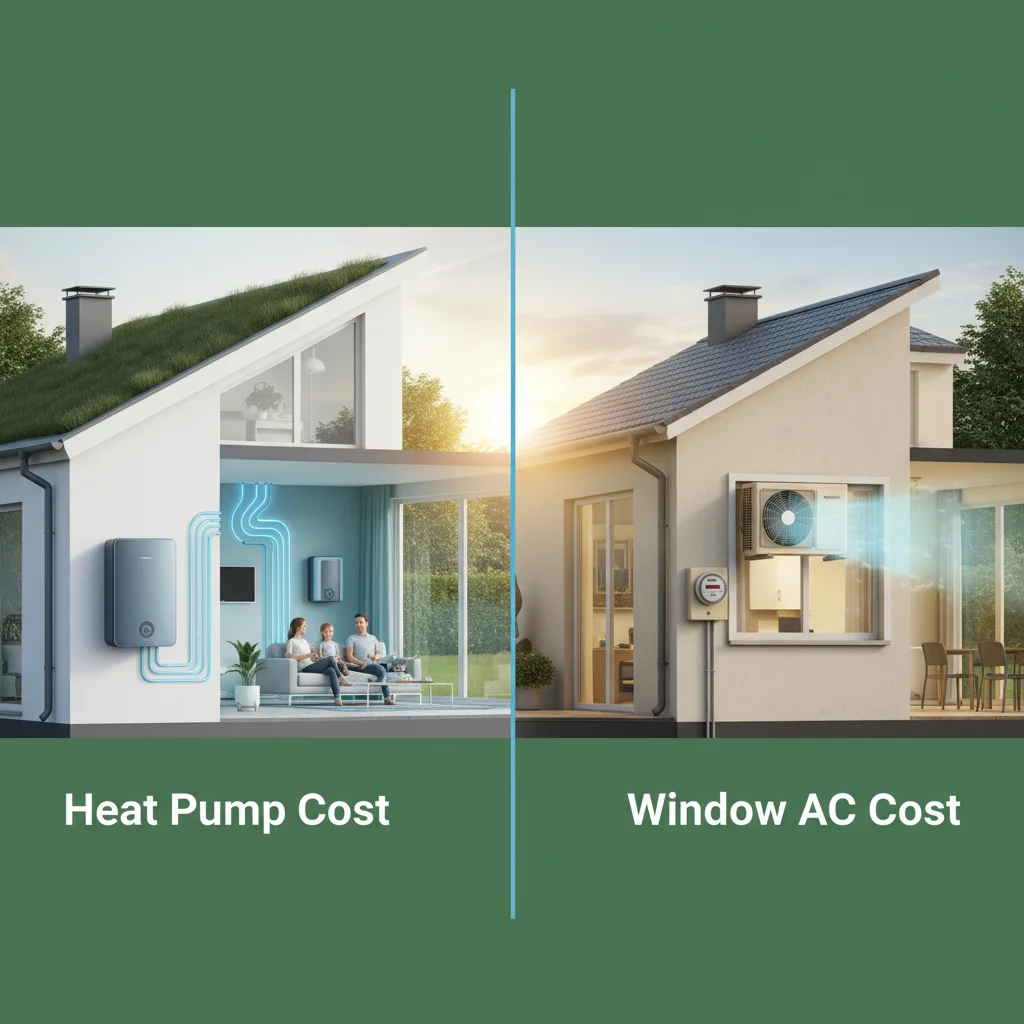
A California homeowner replacing three window AC units with a single heat pump system saved $1,847 in year-one energy costs and unlocked $4,500 in federal tax credits. And that scenario is playing out in thousands of homes across the state as utility bills climb and equipment rebates multiply.
How Much Does a Heat Pump Cost vs. a Window AC Unit?
Heat pumps cost $4,000-$8,000 installed for a ductless mini-split system serving one to three rooms, while window AC units cost $200-$800 per unit. But a single heat pump replaces multiple window units and provides heating in winter, cutting total HVAC costs by 30-50% annually. The federal Energy Efficient Home Improvement Credit (Section 25C) ended for property placed in service after December 31, 2025 (IRS FS-2025-05). Check current state, local and utility incentives for your address with the DuloCore rebate calculator. And California heat pump rebates add another $1,000-$3,000 for qualifying households. (Note: Federal tax credit percentages and availability are subject to change; the 30% Residential Clean Energy Credit under Section 25D expired December 31, 2025. Verify current incentives at energy.gov.)
Window AC units require no installation labor beyond lifting them into a frame, so upfront cost stays under $1,000 for most homes. But running three window units for cooling alone costs $600-$900 annually in electricity, while a heat pump serving the same space costs $400-$550 for both heating and cooling combined. So the equipment price gap closes in 3-5 years through energy savings.
"Ductless heat pumps use 25-50% less energy than window air conditioners and electric resistance heat." — ENERGY STAR
What's the ROI Payback Period for Upgrading from Window AC to a Heat Pump?
Heat pump ROI payback averages 4-7 years for California homeowners replacing window AC units, factoring in federal tax credits and utility rebates. Households that use window units for cooling plus electric baseboard or wall heaters for winter warmth see payback in 3-5 years because the heat pump eliminates both systems. And homes in Climate Zones 1-3 (coastal and valley regions) hit breakeven faster due to moderate heating loads and high cooling demand.
The federal Energy Efficient Home Improvement Credit (Section 25C) ended for property placed in service after December 31, 2025 (IRS FS-2025-05).
Rebates accelerate ROI further. Use our free rebate calculator to find your exact savings based on income, ZIP code, and existing equipment. California's TECH Clean California program and local utility incentives stack with federal credits, delivering combined savings of $2,000-$5,500 on qualifying installs.
Which Climate Zone Should You Choose: Heat Pump or Window AC?
Heat pumps outperform window AC units in California Climate Zones 1-16, which cover 99% of residential areas. Zones 1-5 (coastal and inland valleys) see the strongest cost advantage because mild winters require minimal heating capacity, allowing smaller 12,000-18,000 BTU systems that cost $4,000-$6,000 installed. And Zones 6-10 (mountains and high desert) benefit from cold-climate heat pumps rated to -13°F, eliminating the need for backup resistance heat that window AC users rely on.
Window AC units excel only in single-room cooling scenarios where heating needs are met by natural gas or existing central systems. But that narrow use case shrinks as gas prices rise and building electrification mandates spread. Los Angeles banned gas hookups in new construction starting 2023, and San Francisco followed in 2024. So heat pumps align with long-term energy policy while window units face regulatory headwinds.
Climate zone data shows heat pump efficiency peaks in moderate climates. A ductless mini-split in Oakland (Zone 3) delivers 300-400% efficiency year-round, converting 1 kWh of electricity into 3-4 kWh of heating or cooling. Window units plateau at 100-120% efficiency and provide zero heating, forcing homeowners to run separate electric heaters at 100% efficiency during winter.
"Air-source heat pumps can deliver 1.5 to 3 times more heat energy than the electrical energy they consume." — U.S. Department of Energy
Heat Pump vs. Window AC vs. Central Air: Which Is Most Cost-Effective?
Heat pumps deliver the lowest total cost of ownership for California homes without existing ductwork, averaging $6,000-$10,000 installed compared to $12,000-$18,000 for ducted central air plus furnace. Window AC units cost less upfront at $600-$2,400 for three units, but operating costs hit $800-$1,200 annually versus $500-$700 for an equivalent heat pump system. And central air requires functional ductwork, adding $4,000-$8,000 in retrofit costs if ducts are missing or deteriorated.
Ductless mini-splits emerge as the cost leader for homes under 1,800 square feet. Installation takes 1 day, requires no structural changes, and qualifies for the full 30% federal tax credit plus California rebates. Central air makes sense only when quality ducts already exist and the home exceeds 2,500 square feet, where multi-zone mini-splits become price-competitive with ducted systems.
Operating cost comparisons assume $0.28/kWh average California electricity rates in 2026. A 12,000 BTU window AC unit consumes 1,200 kWh annually for cooling alone, costing $336. Add a 1,500-watt electric heater running 1,000 hours per winter, and the total hits $756. A ductless heat pump serving the same space uses 1,400 kWh for combined heating and cooling, costing $392—a 48% savings. And that gap widens as electricity rates increase 3-5% annually.
Review energy tax credits for stacking federal, state, and utility incentives to maximize savings.
How Long Do Heat Pumps and Window AC Units Last?
Heat pumps last 15-20 years with annual maintenance, while window AC units last 8-12 years before compressor failure or refrigerant leaks require replacement. Ductless mini-splits installed in 2026 will operate through 2041-2046, spanning two or three window AC replacement cycles. And extended lifespan dilutes the upfront cost difference—$6,000 amortized over 18 years equals $333 annually, versus $500 per unit amortized over 10 years for window ACs.
Maintenance frequency impacts longevity. Heat pumps require professional servicing every 12-24 months to clean coils, check refrigerant, and inspect electrical connections, costing $120-$180 per visit. Window units need annual filter cleaning and seasonal removal for winter storage, which homeowners handle without professional help. But neglecting heat pump maintenance cuts lifespan to 10-12 years, erasing the longevity advantage.
Warranty coverage differs significantly. Most ductless heat pumps include 5-7 year compressor warranties and 1-3 year parts coverage, while window units offer 1-2 year limited warranties. So heat pump buyers gain protection during the critical early years when manufacturing defects surface. And extended warranties add $200-$400 but rarely pay off unless the unit fails within the coverage window.
Coastal California climates extend equipment life by reducing freeze-thaw cycles and humidity corrosion. A heat pump in San Diego lasts 18-22 years, while the same model in Sacramento averages 15-18 years due to hotter summers and colder winters that stress components.
Are You Eligible for Heat Pump Rebates and Tax Credits?
The federal Energy Efficient Home Improvement Credit (Section 25C) ended for property placed in service after December 31, 2025 (IRS FS-2025-05). Federal tax credits for this work have ended, but state, local and utility rebates may still apply; check what is available at your address with the DuloCore rebate calculator.
TECH Clean California offers $3,000 rebates for heat pump installations replacing gas furnaces or electric resistance heat in moderate-income households. Southern California Edison provides $2,500-$3,500 for ductless mini-splits through its energy efficiency programs, while PG&E offers $2,000-$2,750. And low-income households earning under 80% area median income qualify for $8,000 federal credits plus enhanced state rebates totaling $4,000-$6,000.
Eligibility verification takes 2-5 minutes using online tools. Check heat pump rebates for program-specific income thresholds, equipment requirements, and application deadlines. Most programs require ENERGY STAR certification, contractor pre-approval, and installation completion within 6-12 months of rebate reservation.
"The Inflation Reduction Act provides tax credits of up to 30% for qualified energy-efficient home improvements, including heat pumps." — DSIRE USA
But program funding is finite. California's TECH Clean California allocated $120 million for 2026, with rebates issued on a first-come basis until funds deplete. And utility programs reset annually, so amounts and eligibility change each January.
Official Sources
- U.S. Department of Energy Save Energy, Save Money — Federal guidance on heat pump efficiency, rebates, and installation best practices.
- ENERGY STAR Heat Pumps — Certification requirements, cost savings calculators, and qualified product database.
- DSIRE USA — Comprehensive database of federal, state, and utility rebate programs updated monthly.
Frequently Asked Questions
Are heat pumps more expensive than window air conditioners?
Heat pumps cost $4,000-$8,000 installed, while window AC units cost $200-$800 each. But federal tax credits reduce heat pump net cost by 30%, and a single mini-split replaces 2-4 window units while adding heating capability. Annual operating costs favor heat pumps at $400-$550 versus $600-$900 for equivalent window AC coverage, creating payback in 4-7 years.
What is the cost difference between installing a heat pump and a window AC unit?
Professional heat pump installation costs $4,000-$8,000 including equipment, labor, electrical upgrades, and permits. Window AC units require no professional installation, with homeowners lifting units into window frames in 15-30 minutes. But DIY window AC installation limits coverage to single rooms, while heat pumps serve 1-3 zones from one outdoor compressor.
Do heat pumps qualify for federal tax credits or rebates?
The federal Energy Efficient Home Improvement Credit (Section 25C) ended for property placed in service after December 31, 2025 (IRS FS-2025-05). California adds $1,000-$3,000 in utility rebates, and low-income households access $8,000 federal credits plus $4,000-$6,000 state incentives. Window AC units receive no federal or state rebates in 2026. Calculate your total savings with our rebate calculator.
How much can you save with a heat pump compared to window AC over time?
California homeowners save $200-$400 annually on electricity by replacing window AC units and electric resistance heat with a heat pump. Over a 15-year lifespan, cumulative savings reach $3,000-$6,000 before factoring in federal credits and rebates. And avoided window AC replacement costs add another $600-$1,200 as units fail every 8-12 years.
What are the installation costs for heat pumps versus window air conditioners?
Ductless mini-split heat pumps cost $3,500-$7,500 for labor, materials, electrical work, and permitting. Multi-zone systems serving 2-4 rooms cost $6,000-$12,000 installed. Window AC units require zero installation labor when homeowners mount units in existing window frames. But contractor installation of window units costs $150-$300 per unit if wall sleeves or structural support are needed.
Ready to calculate your heat pump savings? Use our free rebate calculator to find federal tax credits, California rebates, and utility incentives based on your home's location and income. Get personalized quotes from certified contractors and lock in 2026 program funding before it runs out.
Last updated: April 14, 2026. Reviewed by the DuloCore Editorial Team. About our authors.
Check your California heat pump rebate eligibility — see the programs you qualify for and the dollar amounts on our California heat pump rebate finder.