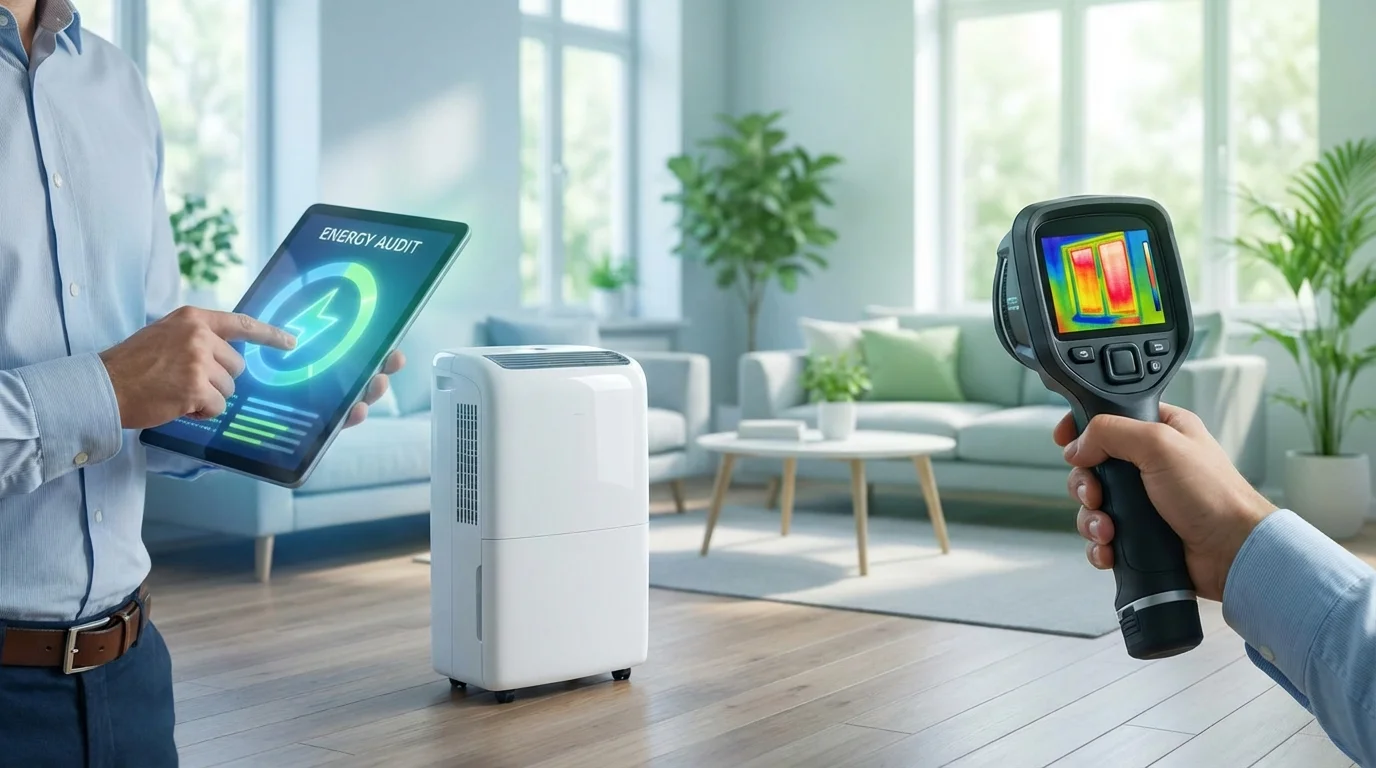
That old dehumidifier in your basement isn't just loud; it's a silent drain on your finances, potentially consuming more electricity than your new refrigerator. A single, inefficient unit running constantly can add over $300 to your annual utility bills without you even noticing. So performing an audit on this appliance's energy use is the first step toward unlocking direct savings and qualifying for 2026 replacement rebates.
How Does a Dehumidifier Energy Consumption Audit Reveal Hidden Savings?
A dehumidifier energy consumption audit is a diagnostic process that identifies energy waste from inefficient units. It quantifies excess kWh usage, revealing potential savings of $50-$150 annually by upgrading to a 2026 ENERGY STAR certified model and pinpointing specific operational inefficiencies causing inflated energy bills.
An audit reveals concrete data, not guesswork. But it starts by measuring the dehumidifier's real-time power draw in watts and tracking its daily run time. So this data exposes how an older unit's degraded components lead to continuous operation, consuming 20-40% more energy than its original rating. The audit also compares the unit’s performance against current ENERGY STAR standards, which require Integrated Energy Factor (IEF) ratings of 1.55 or higher for models under 50 pints/day. And armed with this information—like finding your unit operates at a 0.9 IEF—you have the documentation needed to justify an upgrade. This process is a simplified version of a broader home energy audit, focusing on one high-consumption appliance.
What Local & Utility Rebates are Available for Energy-Efficient Dehumidifiers?
Local utility rebates for 2026 provide homeowners with direct financial incentives, often between $25 and $75, for purchasing ENERGY STAR certified dehumidifiers. These programs, funded by state energy offices, aim to reduce grid load by retiring older, less efficient appliances before they fail.
Utility companies across the country offer these incentives to manage peak electricity demand. And programs like Con Edison's or PG&E's provide instant or mail-in rebates for specific models that meet high-efficiency criteria. So the goal is to accelerate the adoption of technology that uses less power. The U.S. Department of Energy highlights the impact of these upgrades.
"ENERGY STAR certified dehumidifiers use nearly 15 percent less energy than conventional models. This is equivalent to an average of 140 kWh and more than $25 per year in energy bill savings." — U.S. Department of Energy
These rebates make the upfront cost of a new, efficient unit much lower. But homeowners must check with their local provider, as program availability and rebate amounts vary by service area and are updated for 2026.
What Are the Eligibility Requirements and Application Steps for Dehumidifier Rebates?
Eligibility for 2026 dehumidifier rebates typically requires purchasing a new ENERGY STAR certified model and being an active customer of the sponsoring utility. The application process involves submitting a dated sales receipt and the unit's model number online or via mail within 30-90 days of purchase.
To qualify, the dehumidifier must appear on the utility's pre-approved product list, which guarantees it meets specific efficiency standards for the current year. And homeowners must provide proof of purchase that clearly shows the date, retailer, and model number. So the application itself is usually a simple online form or a mail-in document. After submission, a credit of $25 to $75 is applied directly to the utility bill or sent as a check within 6-8 weeks. Use our free rebate calculator to find specific savings and program requirements in your area before purchasing a new unit.
What Are the Deadlines, Funding Status, and Stacking Rules for Dehumidifier Incentives?
Dehumidifier rebate programs for 2026 operate on a first-come, first-served basis with deadlines often set for December 31st or when funds are depleted. Stacking rules vary; some utilities permit combining their rebate with manufacturer discounts but not with other state-level energy grants.
Funding for these programs is finite and often runs out before the end-of-year deadline, making early application critical. And "stacking" refers to using multiple incentives on one purchase. For instance, a utility's $50 rebate is often stackable with a $20 manufacturer's discount. But it typically can't be combined with broader energy tax credits that cover systems like HVAC or solar. Homeowners must verify their local program's rules. The Database of State Incentives for Renewables & Efficiency (DSIRE) is a key resource for this.
"DSIRE is the most comprehensive source of information on incentives and policies that support renewables and energy efficiency in the United States." — DSIRE
So checking the program's terms and conditions is essential to confirm stacking eligibility and avoid application rejection.
2026 Dehumidifier Rebate Program Comparison
| Utility Program | Rebate Amount | Eligibility Requirements | Application Deadline |
|---|---|---|---|
| City Light Energy Savers | $50 | ENERGY STAR certified model, customer in good standing | Dec 31, 2026 |
| State Power Co. Efficiency | $75 | Must recycle old unit, ENERGY STAR certified | Oct 31, 2026 |
| Coastal Electric Cooperative | $25 | Purchase from a local retailer, ENERGY STAR model | When funds are depleted |
Official Sources
- ENERGY STAR — Official government-backed symbol for energy efficiency providing credible, unbiased information.
- DSIRE — The most comprehensive U.S. database for information on incentives and policies that support energy efficiency.
Related Reading: Learn more about Energy Audit Condo Apartment and Energy Audit Log Cabin.
Frequently Asked Questions
What are the eligibility requirements for a dehumidifier energy consumption audit rebate?
Rebates are typically for the purchase of a new, efficient dehumidifier, not the audit itself. So eligibility for a replacement rebate in 2026 requires buying an ENERGY STAR certified model. And you must be a customer of the sponsoring utility. The purchase receipt must be dated within the program year, often between January 1 and December 31, 2026.
What steps are involved in a dehumidifier energy consumption audit?
A DIY audit involves three steps. First, use a plug-in electricity usage monitor to measure the dehumidifier's wattage over a 24-hour period. Second, multiply the daily kWh consumption by your utility's rate to find the daily cost. Third, compare this data to the energy consumption listed for a new 2026 ENERGY STAR model, which often uses 15% less electricity.
What rebate amounts can I expect after completing a dehumidifier energy audit?
The audit identifies potential savings, which then justifies purchasing a new unit eligible for a rebate. And typical utility rebates for ENERGY STAR certified dehumidifiers in 2026 range from $25 to $75. So the exact amount depends entirely on your local utility provider's specific program offerings for the year. Higher-efficiency models sometimes qualify for larger amounts.
Are there specific deadlines to submit a dehumidifier energy consumption audit for a rebate?
There is no deadline for an audit, but there are strict deadlines for rebate applications. Most 2026 utility programs require you to submit your application within 30 to 90 days of purchasing the new dehumidifier. And all programs have a final deadline, typically December 31, 2026, or whenever the program's limited funds are fully disbursed.
How does a dehumidifier energy consumption audit compare to a general home energy audit for rebate purposes?
A dehumidifier audit is a single-appliance check you can perform yourself to justify an upgrade. But a general home energy audit is a comprehensive professional service that assesses your entire home's energy use, from insulation to HVAC systems. So the full audit qualifies for much larger rebates, often $150-$500, and unlocks access to incentives for bigger projects like heat pump rebates.
Unlock Your Dehumidifier Rebates
Your old dehumidifier is costing you more than you think. Find out exactly how much you can save with a new energy-efficient model. Use our free, up-to-date rebate calculator to see available 2026 incentives in your area.
Calculate Your Savings NowLast reviewed: April 14, 2026. Reviewed by DuloCore Energy Specialists. About the team.