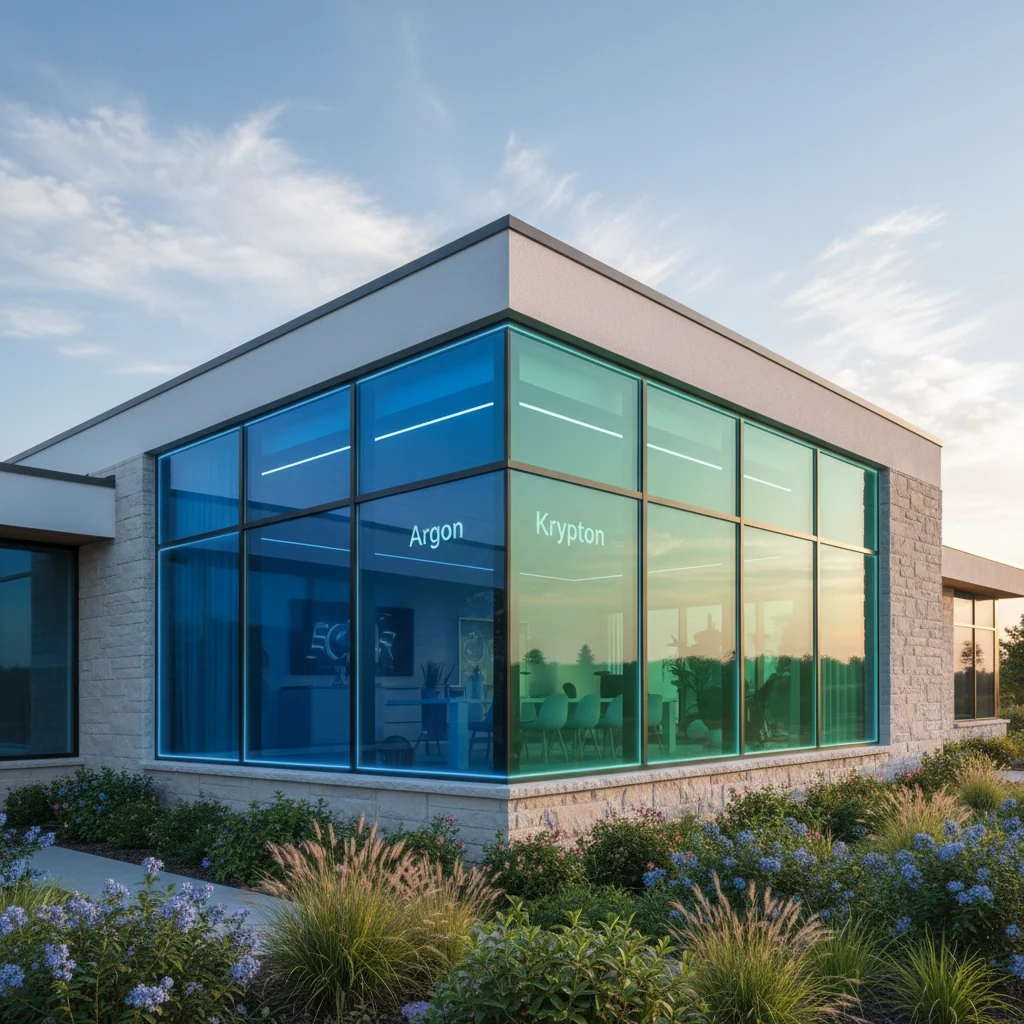
Up to 30% of a home's heating and cooling energy loss occurs through windows and doors. The invisible gas sealed between your window panes—argon or krypton—directly impacts that number, determining how much of your energy bill literally goes out the window each month. So this choice directly influences your home's thermal performance and your eligibility for valuable 2026 energy rebates.
What Are the Key Differences Between Argon and Krypton Windows, and How Do Their Typical and Installation Costs Compare?
Argon-filled windows are the industry standard, offering a 16% improvement in thermal resistance over air-filled units for a typical cost of $300-$850 per window. But krypton, a denser gas, provides 27% better insulation, making it superior for narrower gaps in triple-pane windows, though its cost is higher at $450-$1,200 per window.
So, the central tension for homeowners is balancing upfront cost against long-term energy savings and rebate eligibility. Argon is more affordable, with a typical dual-pane window costing around $600 including installation. Krypton adds approximately $150-$350 per window to the total cost. And this initial investment difference dictates the payback period and the total return on investment, which is a critical calculation before purchase. Choosing the wrong gas for your climate zone results in either overspending on technology you don't need or forfeiting hundreds in local utility rebates.
The primary difference lies in thermal conductivity and cost. Argon is a cost-effective insulator, making it standard for most dual-pane windows. So its installation cost is baked into the typical window price of $300 to $850. Krypton is a denser, more effective insulator, but it's also rarer and more expensive. And this makes it the preferred choice for high-performance triple-pane windows where the gap between panes is smaller (typically 1/4" to 3/8"). The installation cost for krypton windows doesn't change, but the unit price increases by 25-40% over argon. So homeowners often choose argon for its balance of performance and price, while those in extreme climates or seeking maximum efficiency opt for krypton, despite the higher initial outlay of $450 to $1,200 per unit.
How Do Argon and Krypton Windows Rank in Efficiency Ratings and Which Climate Zones Suit Them Best?
Krypton-filled windows consistently achieve lower U-factors, typically ranging from 0.15 to 0.25, making them ideal for colder climates in ENERGY STAR Zones 5-8. But argon windows, with U-factors between 0.24 and 0.30, provide excellent performance and value for mixed and southern climates in Zones 1-4.
Efficiency ratings like U-factor and Solar Heat Gain Coefficient (SHGC) quantify a window's performance. Krypton's density allows it to slow heat transfer more effectively than argon, resulting in a lower U-factor—a key metric for window replacement rebates. For example, in Northern climate zones like Minnesota or Maine (Zone 6-7), a krypton-filled triple-pane window with a U-factor of 0.20 is often required to maximize utility rebates. And argon-filled dual-pane windows with a U-factor of 0.27 are perfectly suited and cost-effective for Southern zones like Texas or Florida (Zone 1-2). So aligning the gas type with your region's specific ENERGY STAR requirements is essential for both energy savings and qualifying for financial incentives. The Department of Energy provides clear guidance on these regional needs.
"To choose the right windows for your home, you'll need to understand their performance ratings and how they can improve your home's energy efficiency." — U.S. Department of Energy
What Rebates and Incentives Are Available for Argon and Krypton Windows, and Which Brands Qualify for Eligibility?
The federal Energy Efficient Home Improvement Credit (Section 25C) ended for property placed in service after December 31, 2025 (IRS FS-2025-05). Federal tax credits for this work have ended, but state, local and utility rebates may still apply; check what is available at your address with the DuloCore rebate calculator. And qualifying brands like Pella, Andersen, and Marvin offer windows that meet the required U-factor and SHGC ratings.
The availability of rebates depends on meeting specific performance criteria, not the type of gas used. The federal Energy Efficient Home Improvement Credit (Section 25C) ended for property placed in service after December 31, 2025 (IRS FS-2025-05). And many state and local utility programs offer additional rebates, often ranging from $25 to $100 per window. For example, a utility in the Northeast may offer $75 for each triple-pane, krypton-filled window with a U-factor ≤ 0.22. Qualifying brands include Andersen (400 Series), Pella (Lifestyle Series), and Marvin (Elevate Collection), all of which have product lines designed to meet or exceed these rebate specifications. Use our free rebate calculator to find savings in your area.
What is the Expected ROI and Payback Period for Investing in Argon vs. Krypton Gas-Filled Windows?
Argon windows typically offer a payback period of 8-12 years, with an ROI driven by moderate upfront costs and annual energy savings of $125-$500. But krypton windows, due to their higher initial cost of 25-40%, have a longer payback period of 12-18 years.
The return on investment for new windows is a function of energy savings, upfront cost, and available incentives. For a typical home, replacing single-pane windows with argon-filled ENERGY STAR models saves between $126 and $583 annually. So with an average cost of $6,000 for 10 windows, the simple payback period is around 10 years, not accounting for rebates that can shorten it. Krypton windows save an additional 5-10% on energy bills compared to argon. But their higher cost—an extra $2,000-$3,500 for the same 10 windows—extends the payback period. The ROI is highest for krypton in extremely cold climates where the enhanced insulation provides a greater reduction in heating costs, justifying the premium investment over the home's lifespan.
How Do the Lifespan, Maintenance Requirements, and Alternative Window Options Compare for Argon and Krypton?
Both argon and krypton-filled insulated glass units (IGUs) have a typical lifespan of 20-30 years, with minimal maintenance beyond standard cleaning. And if the seal fails, the gas can be replaced, though full window replacement is common. Alternatives include vacuum insulated glass (VIG) technology.
The lifespan of gas-filled windows depends entirely on the integrity of the window seal, not the gas itself. Both argon and krypton are stable, inert gases that don't degrade. So a high-quality window from a reputable manufacturer will retain at least 90% of its gas for over 20 years. Maintenance involves cleaning the glass and inspecting the seals for signs of failure, such as condensation between the panes. If a seal breaks, the window loses its insulating properties. And while refilling is technically possible, it's often not cost-effective. The primary alternative is vacuum insulated glass (VIG), which offers superior insulation (U-factors as low as 0.08) but comes at a 40-60% cost premium over krypton, making it a niche option for projects like historic retrofits or high-performance buildings. Other efficiency upgrades like heat pump rebates often provide a faster ROI.
2026 Window Rebate Program Comparison
| Feature | Federal IRA Tax Credit | Typical Utility Rebate | State Energy Program |
|---|---|---|---|
| Max Amount | Ended Dec 31, 2025 | $25 - $100 per window | $200 - $1,500 total |
| Eligibility | — | U-factor/SHGC targets (e.g., U ≤ 0.25) | Varies by state; often income-based |
| Gas Type | — | Both qualify if efficiency specs are met | Both qualify if efficiency specs are met |
| Deadline | Ended Dec 31, 2025 | Varies; often annual programs | Varies; check state energy office |
Official Sources
- ENERGY STAR Windows — Official criteria for windows, doors, and skylights to earn the ENERGY STAR label, including climate zone maps and performance requirements.
- DSIRE Database — A comprehensive database of state, local, utility, and federal incentives and policies that promote renewable energy and energy efficiency.
Frequently Asked Questions
What are the key differences between argon and krypton gas windows for energy efficiency rebates?
For rebates, the key difference isn't the gas itself but the final efficiency rating (U-factor) it helps the window achieve. Krypton enables lower U-factors, often below 0.22, which is a requirement for top-tier rebates in colder climates. So argon-filled windows typically qualify for standard rebates with U-factors around 0.25-0.27, while krypton is often necessary to meet the stricter performance targets for maximum incentive amounts, especially in programs offering over $75 per window.
Do windows filled with krypton gas qualify for higher home improvement rebates than argon-filled windows?
Yes, krypton-filled windows often qualify for higher rebate tiers. While both gases can be in ENERGY STAR certified windows, many utility programs offer tiered incentives based on U-factor. For example, a program may offer $50 for a window with a U-factor of 0.25 (achievable with argon) but increase the rebate to $100 for a U-factor of 0.20, which typically requires krypton. So the higher performance of krypton directly unlocks larger 2026 rebate amounts.
Is the upfront cost difference between argon and krypton gas windows offset by potential rebate amounts?
No, rebates alone typically don't offset the full upfront cost difference. Krypton adds $150-$350 per window, while the incremental rebate increase is often only $25-$50 per window. The primary financial benefit comes from long-term energy savings over 20+ years, especially in regions with extreme heating costs. So the decision to invest in krypton should be based on total lifecycle savings, not just the immediate rebate bump.
Find Your Window Rebates in Seconds
Don't guess what you qualify for. Our tools instantly search state and utility programs to find every dollar you're owed for your new windows.
Calculate Your Savings NowUpdated: April 14, 2026 — fact-checked by DuloCore Research. About our editorial process.
Check your California insulation rebate eligibility — see the programs you qualify for and the dollar amounts on our California insulation rebate finder.